Introduction
The speculation is over. OpenAI has officially announced that ads are coming to ChatGPT, with testing beginning in the coming weeks for Free and Go tier users in the United States. This marks one of the most significant shifts in digital advertising since the rise of paid social media, and it’s happening faster than many predicted.
For marketers, founders, and business owners, the introduction of ChatGPT ads represents a fundamentally new advertising channel, one that sits at the intersection of search intent, conversational AI, and decision-making. Unlike traditional ad platforms where users browse passively, ChatGPT users are actively asking questions, comparing options, and making purchase decisions in real time.
The businesses that understand this shift and prepare now will gain substantial first-mover advantages. This guide covers everything we now know about ChatGPT ads, what remains unclear, and exactly how to position your business for success.
What We Predicted vs. What’s Confirmed
In our earlier analysis, we predicted that ChatGPT ads would emerge in 2026 based on hiring patterns, industry reporting, and leadership signals. OpenAI moved faster than expected, announcing their ad testing plans in early 2026 with a clear framework and public commitment to user trust.
What we got right: We correctly anticipated that ads would be clearly labeled and separated from organic responses, that OpenAI would prioritize transparency and user control, that the format would be conversational and intent-driven, that small businesses would benefit from early adoption opportunities, and that privacy and data protection would be central to the platform’s approach.
What’s clear now: We now have confirmed ad formats with bottom-of-response placements and conversational follow-up capabilities, explicit advertising principles published by OpenAI, geographic rollout starting in the U.S. for Free and Go tiers, confirmation that Plus, Pro, Business, Enterprise, and Edu accounts will remain ad-free, and a testing timeline that moved up significantly from our original projections.
The core thesis remains accurate: ChatGPT ads represent a massive shift in how people discover and evaluate products and services online.
Why ChatGPT Ads Matter More Than Ever
AI assistants are rapidly becoming the primary layer between users and the web. Gartner forecasts that traditional search engine volume will decline by 25% by 2026 as AI chatbots replace conventional search queries. This isn’t a gradual shift, it’s an acceleration. Marketers are already seeing the impact, with 68% currently utilizing AI in their daily tasks and 88% believing they must implement AI technology to stay competitive.
The Intent Advantage
Unlike search engines, where ads interrupt a list of links, ChatGPT sits inside the user’s thinking process. People use it to compare vendors, research products, summarize reviews, and make purchase decisions. ChatGPT operates at the point of highest commercial intent, often moments before a user commits to a provider or product.
The trust dynamic is fundamentally different. Users treat conversational AI more like an advisor than a media channel. When ads appear in this environment, clearly labeled but deeply integrated into the decision-making process, they carry a level of relevance and timing that traditional display or search ads cannot match. Recent research shows that 71% of consumers believe they have seen AI-generated ads, indicating growing familiarity with AI-powered advertising experiences.
The Zero-Click Future?
From a user behaviour perspective, discovery and decision-making might as well become “zero-click”: no websites, no search engine results pages, just a conversational interface that delivers answers and options. For small businesses and emerging brands, this creates early-mover advantages similar to those experienced by the first generation of Google Ads advertisers in the mid-2000s.
The businesses that establish presence, relevance, and trust in ChatGPT now will benefit from lower competition, novel ad formats, and high conversion intent before the platform becomes saturated.
What We Know: OpenAI’s Official Ad Framework
OpenAI has published a comprehensive set of advertising principles that define how ads will function in ChatGPT. This level of transparency is unusual for a major platform launch and signals OpenAI’s awareness of the trust users place in the product.
Confirmed Ad Formats
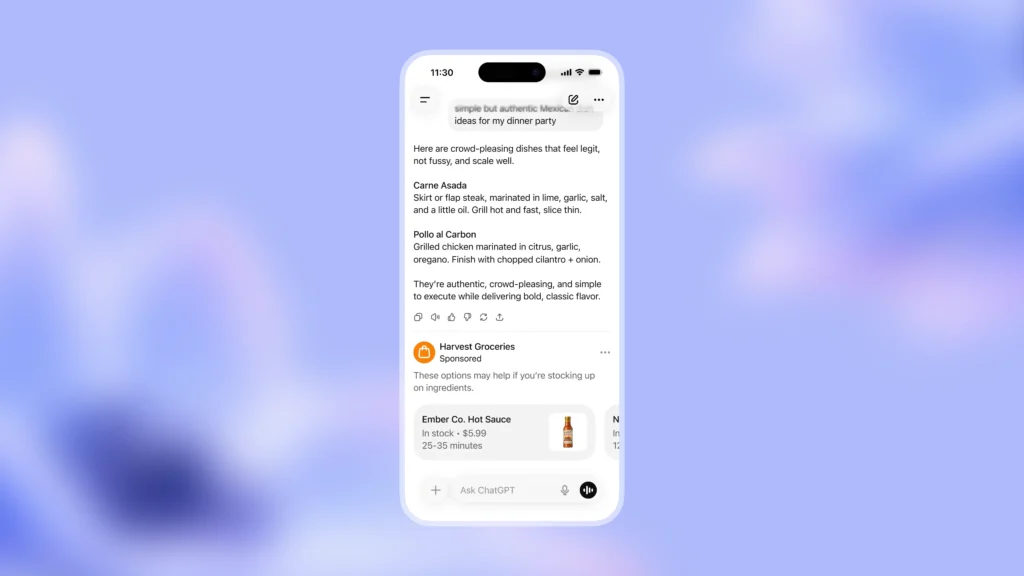
OpenAI plans to test ads that appear at the bottom of ChatGPT’s answers when there’s a relevant sponsored product or service based on the current conversation. These ads will be clearly labeled as sponsored content, separated visually from organic responses, contextually relevant to the user’s query, and dismissible with feedback options explaining why the user doesn’t want to see it.
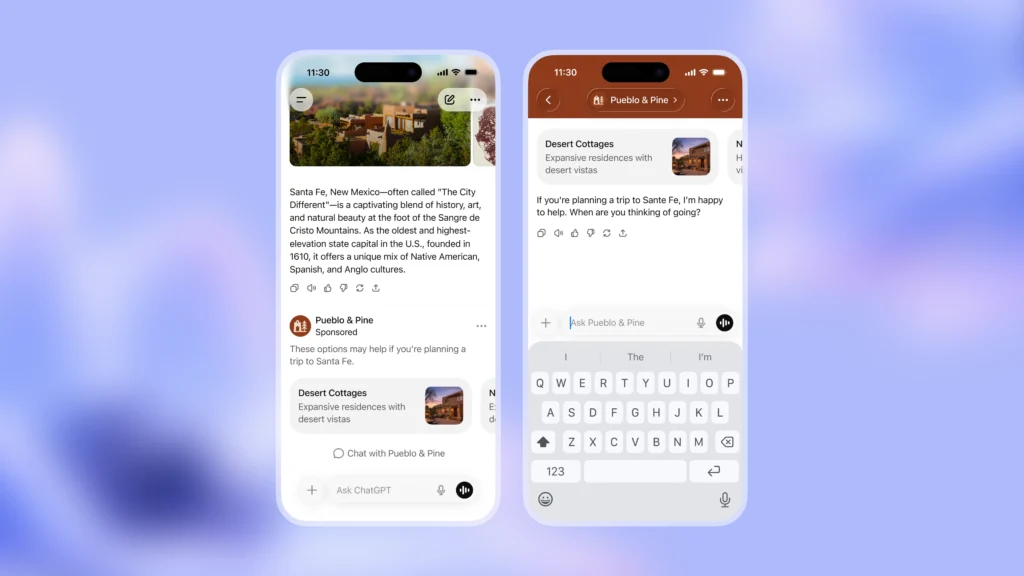
Additionally, OpenAI has shown early concepts for conversational ad interactions, where users can ask follow-up questions directly to advertisers. For example, a user researching travel destinations might see a sponsored listing for accommodations and be able to ask questions about availability, pricing, or amenities without leaving the ChatGPT interface.
OpenAI’s Advertising Principles
OpenAI has committed to five core principles governing how ads will function. In summary, these principles ensure that advertising supports OpenAI’s mission to make AI accessible, that ads never influence ChatGPT’s objective responses, that user conversations remain private and data is never sold to advertisers, that users maintain full control over personalization and can access ad-free tiers, and that user trust and experience take precedence over revenue optimization. You can read the full principles here.
Who Will See Ads
Ads will initially be tested with Free tier users and Go tier users who are logged-in adults in the U.S. Ads will not appear for Plus, Pro, Business, Enterprise, or Edu subscribers, users under 18 (predicted or confirmed), or in conversations involving sensitive topics such as health, mental health, or politics.
This segmentation means that premium users maintain an ad-free experience, while free users gain expanded access with fewer usage limits in exchange for seeing ads.
Privacy and Data Use
OpenAI has explicitly stated that conversations are not shared with advertisers, user data is never sold to advertisers, users can turn off ad personalization at any time, and users can clear all data used for ads whenever they choose. If a user chooses to message an advertiser through an ad (for example, to ask follow-up questions), the advertiser only sees the messages sent directly to them, not the full ChatGPT conversation history. More details are available in OpenAI’s official help documentation.
What Remains Unclear
Despite OpenAI’s transparency, several critical details remain unconfirmed.
Targeting capabilities are still undefined. We don’t yet know how advertisers will target users, whether through query intent (e.g., “looking for project management software”), topic categories (e.g., travel, finance, productivity), industry verticals (e.g., B2B SaaS, e-commerce, local services), or behavioral signals. The balance between relevance and privacy will define how sophisticated targeting becomes.
Pricing models have not been disclosed. OpenAI could adopt CPC (cost per click), CPM (cost per thousand impressions), CPA (cost per acquisition), or introduce conversational engagement pricing, a new model specific to AI assistants where advertisers pay for meaningful interactions rather than clicks.
Attribution and measurement present unique challenges. Traditional attribution models assume a linear path from ad exposure to conversion, but ChatGPT ads collapse the funnel: research, evaluation, and decision-making happen in a single conversational session. How will conversions be tracked if users never click through to a website? How will ChatGPT attribute influence when users ask follow-up questions but convert later? Expect new KPIs such as assistant influence score (how often ChatGPT mentions or recommends a brand), conversational engagement rate (how many users interact with an ad beyond viewing it), and share of assistant visibility (brand presence compared to competitors in relevant queries).
Geographic expansion beyond the U.S. has not been confirmed, and regulatory requirements vary significantly by region. In the EU, the AI Act and Digital Services Act impose strict transparency and accountability standards that will shape how ads function globally.
How Businesses Should Prepare Now
Even without complete details, businesses can take strategic steps to position themselves for ChatGPT ads. The companies that act now will gain significant advantages when the platform opens more broadly.
1. Audit Your Conversational Presence
Start by understanding how ChatGPT currently describes your business. Ask ChatGPT: “What do you know about [your company name]?”, “What are the best [your product category] providers?”, and “Compare [your company] to [competitor].” Evaluate whether ChatGPT recommends your business for relevant queries, whether the information is accurate (services, pricing, service area), and whether competitor data is more complete or favorable than yours. If ChatGPT’s knowledge is outdated or incomplete, work to strengthen your public-facing content, particularly on authoritative platforms like your website, industry directories, and review sites.
2. Prioritize Authoritative, Factual Content
ChatGPT draws from structured, credible sources. Brands with strong factual content are more likely to be referenced organically and, eventually, deemed relevant for ad placements. Focus on clear product and service descriptions with specific features and use cases, pricing transparency where appropriate, expertise signals such as case studies and thought leadership, and structured data on your website (schema markup for products, services, reviews). The better your content aligns with how AI models process and retrieve information, the stronger your organic and paid presence will be.
3. Strengthen First-Party Data and Attribution
Every new ad platform rewards advertisers with clean data infrastructure. Ensure that your CRM is accurate, deduplicated, and properly segmented, that UTM parameters and naming conventions are standardized across campaigns, that lead routing is fast and reliable, and that tracking aligns with GA4 and offline conversion systems. When ChatGPT ads launch, attribution will likely look different from traditional search or social. Solid data foundations will help you adapt quickly and measure incrementality accurately.
4. Build Your Measurement Framework
Create space in your reporting for a new channel now, even before ads go live. Add a placeholder budget line for “AI assistant spend,” define rules for evaluating incremental conversions (how will you know if ChatGPT drove a lead?), set benchmarks for CPA and ROAS comparisons against existing channels, and document policies for mixed conversion paths (e.g., ChatGPT research followed by Google Search conversion). Treat ChatGPT ads like an upcoming beta channel: you’ll want to test it without disrupting existing campaigns or attribution models.
5. Prepare for Brand Safety and Compliance
ChatGPT will operate under stricter advertising rules than traditional platforms, particularly as AI regulation evolves. Businesses in regulated industries (healthcare, finance, legal services) should create internal guidelines for acceptable messaging and claims, transparency requirements for disclosures, prohibited language or comparisons, data privacy and consent standards, and ethical advertising practices. Ethics is becoming a competitive advantage in marketing, not a constraint. Companies that navigate AI advertising responsibly will build stronger trust with users and regulators.
6. Explore Early Partnership Opportunities
While OpenAI is focused on internal testing initially, they have indicated interest in learning from early feedback. If your business operates in a category that aligns with ChatGPT’s user base (productivity tools, e-commerce, travel, education, professional services), consider expressing interest in early testing programs, monitoring OpenAI’s updates for advertiser onboarding, and connecting with agencies or platforms that may have early access. First-generation advertisers on new platforms often receive preferential pricing, dedicated support, and influence over product development.
Budget Impact and Reallocation Strategy
When ChatGPT ads launch, most businesses should approach the channel as a test, not a full-scale reallocation. A reasonable forecast for the first 6–12 months includes 2–5% of total ad spend allocated for testing and learning, 5–15% reallocation from Google Search if ChatGPT ads outperform in intent-rich, comparison-heavy queries, and minimal immediate impact on Meta (different intent layer; social ads serve awareness and retargeting, not active decision-making).
The Measurement Challenge
AI assistants collapse the traditional funnel. Research, evaluation, and comparison happen in one conversational interface, often without the user ever visiting a website. Traditional last-click attribution will not capture this behavior. Expect to develop new KPIs alongside standard metrics: assistant influence score, conversational engagement, zero-click conversions (sales or leads generated without website visits), and share of visibility. Budget allocation will need to evolve alongside these metrics. The businesses that invest in robust measurement early will be able to scale ChatGPT ads confidently.
What This Means for Different Business Types
Small businesses and local services will benefit from ChatGPT’s conversational format, which rewards relevance and helpfulness over ad spend. Unlike Google Ads, where established brands dominate high-intent keywords with large budgets, ChatGPT creates opportunities through highly contextual ad placements, conversational interactions that allow users to ask questions before committing, and lower competition in early testing phases.
E-commerce and direct-to-consumer brands stand to benefit significantly. Users already ask ChatGPT for product recommendations, comparisons, and reviews. Ads that appear in these moments, with the ability to answer follow-up questions conversationally, can drive high-intent traffic. Focus on product-specific content that ChatGPT can reference organically, clear differentiation from competitors, and conversational ad copy that invites questions rather than demanding clicks.
B2B and SaaS companies can reach decision-makers at the exact moment they’re evaluating solutions. B2B buyers increasingly use AI assistants to research vendors, compare features, and evaluate pricing. Strategic priorities include thought leadership and expertise content that positions your brand as authoritative, clear explanations of your product or service, and case studies that ChatGPT can reference.
Agencies and marketing teams managing multi-channel campaigns should prepare clients for ChatGPT ads now. Early adopters will gain competitive advantages, and agencies that demonstrate expertise in AI advertising will differentiate themselves. Action steps include educating clients on the opportunity and timeline, auditing client conversational presence and content quality, building measurement frameworks and reporting templates, and monitoring OpenAI announcements for advertiser onboarding details.
The Death of the SERP?
Every few years, the digital marketing industry faces another “the sky is falling” prediction. SEO is declared dead with every algorithm update. PPC is supposedly mummified and replaced by vibes-based marketing. Yet somehow, search ads continue to generate billions in revenue, SEO agencies scale year over year, and nobody’s complaining about returns, they’re running toward the next opportunity.
The question isn’t whether traditional search engines will disappear, it’s how AI assistants and search engines will coexist and complement each other. Both serve different needs in the customer journey.
Search engines excel at broad discovery, comparison across multiple sources, visual browsing experiences, and transactional queries where users want to see multiple options simultaneously. AI assistants excel at synthesizing information, conversational problem-solving, narrowing choices through dialogue, and answering complex questions that require nuanced understanding.
Consider how people actually behave. Someone might use ChatGPT to understand “what type of CRM is best for a 20-person sales team,” then switch to Google to visually compare pricing pages and reviews across multiple vendors. Another user might Google “best Italian restaurants near me,” browse photos and menus, then ask ChatGPT to help them decide between the top three based on specific dietary needs.
The reality is that both channels will coexist, just as TV ads didn’t kill radio, and social media didn’t kill search engines. Industry data shows that 71% of businesses use AI for marketing, but those same businesses continue to invest in traditional channels because they work. The key is understanding when users prefer each interface and building presence across both.
Marketers who position ChatGPT ads as a complement to existing search strategies, rather than a replacement, will capture the most value. The businesses that win will be those that show up where their customers are, whether that’s a search results page, an AI conversation, or both.
The Long-Term Implications
ChatGPT ads are not just another ad format. They represent a fundamental shift in how people discover, evaluate, and choose products and services. The implications extend beyond marketing.
Conversational commerce is rising. E-commerce may increasingly happen inside conversational interfaces. Rather than browsing product pages, users will describe what they need, ask follow-up questions, and potentially complete purchases without ever visiting a website. Research indicates that consumers are actively using AI tools like ChatGPT to shop online, find and compare products, and make purchasing decisions. Brands that optimize for this experience will capture more conversions.
Trust becomes a competitive moat. In a world where AI assistants mediate purchasing decisions, trust becomes the defining competitive advantage. The brands that ChatGPT recommends organically, the brands that advertise transparently, and the brands that prioritize user experience over aggressive monetization will win long-term market share. Consumer research shows that while 71% of Gen Z and Millennial consumers have seen AI-generated ads, there’s a significant trust gap, with consumers valuing transparency and disclosure in AI advertising.
AI marketing investment is accelerating. The AI in marketing market is valued at 47.32 billion US dollars in 2025 and is expected to grow at a CAGR of 36.6% to reach 107.5 billion by 2028. This signals that AI-powered advertising, including ChatGPT ads, will become a standard part of marketing budgets, not an experimental side project.
Conclusion
OpenAI’s announcement of ChatGPT ads marks the beginning of a new era in digital marketing. The shift from traditional search to conversational AI is happening faster than many anticipated, and the businesses that prepare now will be positioned to capture significant advantages when the platform opens more broadly.
The details are still emerging, but the direction is clear: AI assistants are becoming the primary interface between users and information, and advertising in these environments will require new strategies, new measurement frameworks, and a renewed focus on trust and transparency.
Whether you’re a small business owner, a marketing leader, or an agency managing multi-channel campaigns, this is the moment to strengthen your foundations, audit your conversational presence, and position your business for the next major shift in digital discovery. The opportunity is real, the timeline is now, and the businesses that act decisively will reap the rewards.
Want help preparing for ChatGPT ads? Contact us to discuss how your business can position itself for success in the age of conversational AI advertising.